
Comprehensive Analysis of Transmission, Tropism, and Livestock Epidemiology of Avian Influenza Viruses (CATTLE AIV)
The project addresses the growing threat posed by highly pathogenic avian influenza in livestock. The aim of the project is to deepen understanding of virus–host interactions, identify factors that drive cross-species transmission, and support the development of effective prevention strategies. By combining expertise across virology, epidemiology and animal health, the project consortium seeks to strengthen preparedness measures and protect both agricultural systems and public health.

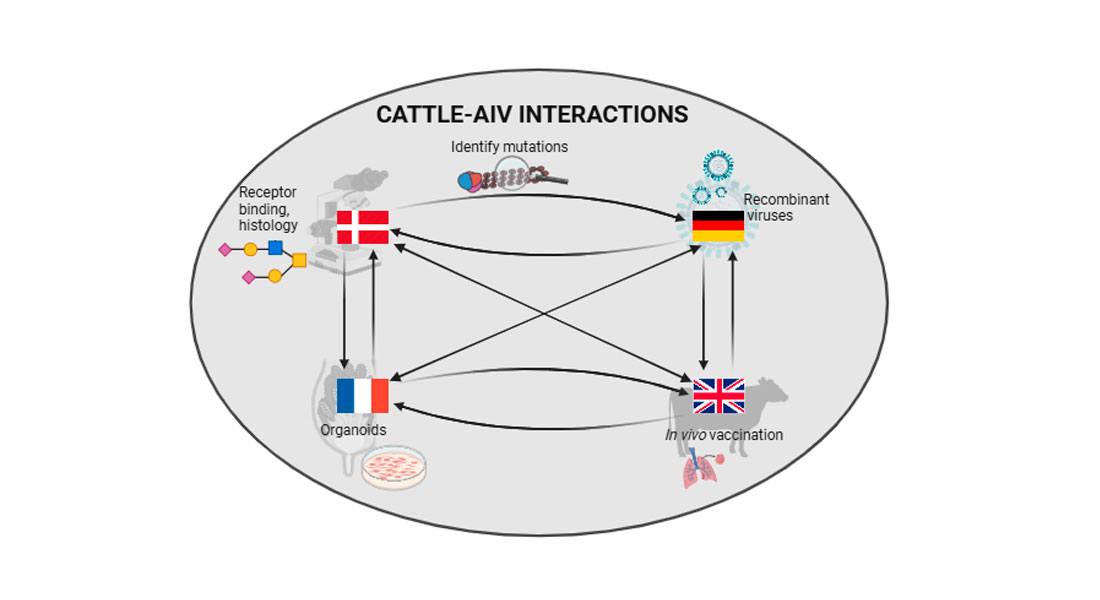
The project consists of researchers from University of Copenhagen, University of Freiburg (Germany), Pirbright Institute (UK) and the National Research Institute for Agriculture, Food and Environment (France).
High pathogenicity avian influenza A viruses (HPAIV) are important pathogens threatening both animal welfare and human health. Since 2022, HPAIVs of the H5Nx subtype have become panzootic and continue to increase both their geographic spread and host range.
Outbreaks in wild bird populations as well as poultry result in mass mortality leading to huge economic losses and potential spillovers to other species. In particular mammalian spillover infections are causing major concerns, as each case offers a chance for mammalian adaptation, thereby potentially increasing the zoonotic risk. The list of mammalian hosts infected with HPAIV is ever-expanding and in some cases, mammal-to-mammal transmission has been observed.
Most recently, H5 HPAIV outbreaks in dairy cattle in the US have demonstrated the potential of these viruses to open new reservoirs for circulation. It is therefore of utmost importance to study these viruses, the potential hosts they can infect, and prevention measures to limit their future spread in livestock species.
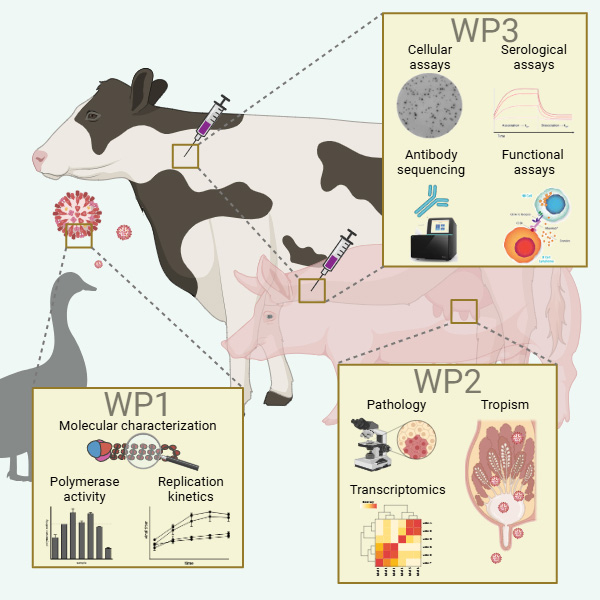
This project is divided into 3 work packages:
Work package 1
We plan to study relevant H5 HPAIVs in molecular detail using in vitro assays to identify genetic markers of interest before validating and further characterizing them via reverse genetics.
Work package 2
This work package will focus on potential mammalian hosts, including cattle and pigs. As the mammary glands of lactating cows are known viral replication sites, we will study these using histopathology and transcriptomic approaches on mammary gland organoids and tissues from infected animals.
Work package 3
In this work package we will investigate the immune response against H5 HPAIV in pigs and lactating cattle after vaccination with three types of vaccine and compare to those from in vivo infected cattle and pigs.
The consortium structure of the project is as follows:
From Denmark
- University of Copenhagen (Department of Veterinary and Animal Science) with support from Innovation Fund Denmark
From Germany
- University of Freiburg (Universitätsklinikum) with support from Bundesanstalt für Landwirtschaft und Ernährung
From England
- The Pirbright Institute with support from Department for Environment, Food and Rural Affairs
From France
- National Research Institute for Agriculture, Food and Environment (INRAE) with support from Agence National de la Recherche
Funded by

CATTLE AIV has received a three year funding from European Partnership on Animal Health and Welfare (EUPAHW)
Period: 2025 - 2028
Grant size: 2,068,800.00 €
Contact
Philipp Peter Petric, project manager
Department of Veterinary and Animal Sciences
Section for Bacteria and Viruses
E-mail: ppp@sund.ku.dk
Phone: +45 3533 1118
Louise Fredsbo Karlsson, project coordinator
Department of Veterinary and Animal Sciences
Section for Bacteria and Viruses
E-mail: louise.karlsson@sund.ku.dk
Phone: +45 3533 2480
In collaboration with



Researchers from University of Copenhagen
| Name | Title | |
|---|---|---|
| Lars Erik Larsen | Professor | |
| Philipp Peter Petric | Postdoc | |
| Charlotte Kristensen | Postdoc | |
| Yuan Liang-Bentsen | Postdoc |
Researchers from University of Freiburg
| Name | Title | |
|---|---|---|
| Martin Schwemmle | Professor, Dr. | |
| Peter Reuther | Team leader, Dr. | |
| Elias Bendle | Dr. |