
Aldana Lab
Understanding brain metabolism to identify new therapeutic strategies for neurodegenerative disease
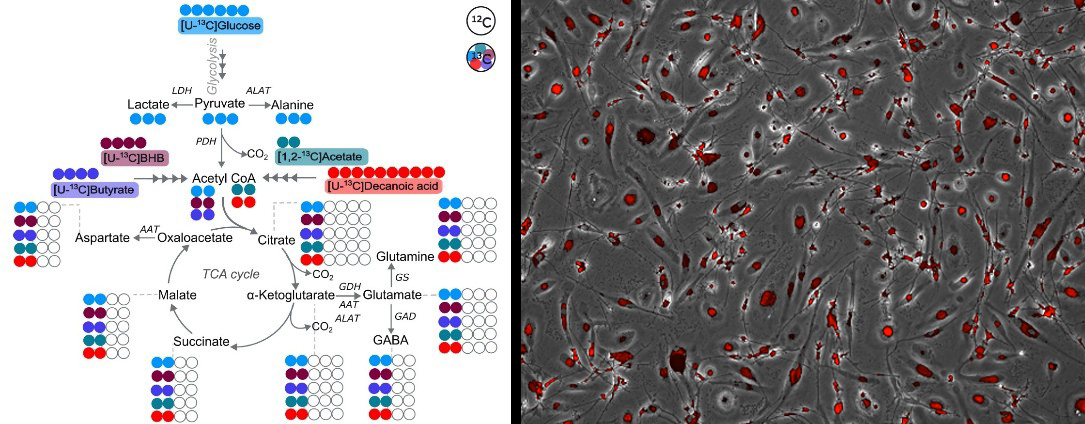
Our research investigates how the metabolism of brain cells supports neuronal function and how disturbances in these processes contribute to neurodegenerative disease. A central focus is the metabolic and biochemical communication between microglia, astrocytes and neurons, and how this cellular crosstalk changes during neuroinflammation and neurodegeneration.
By combining metabolic mapping, neuroscience and pharmacology, the Aldana lab aims to identify metabolic pathways and glial targets that can be exploited therapeutically, particularly in Alzheimer’s disease and related dementias.
Research focus
The brain has exceptionally high and continuously changing energy demands. Maintaining neuronal signalling therefore depends on tightly coordinated metabolic interactions between neurons and glial cells. Our research seeks to understand these interactions at the molecular and cellular level and to determine how they become disrupted in neurological disease. In particular, we investigate the roles of microglia and astrocytes in regulating neuronal energy metabolism, amino-acid metabolism and neurotransmitter homeostasis.
A major current focus is microglial immunometabolism. Microglia are the resident immune cells of the brain, but they are also metabolically active cells capable of influencing the metabolism and function of neighbouring neurons. Our work examines how inflammatory activation alters microglial metabolism, how microglia communicate metabolically with neurons and astrocytes, and whether these processes can be pharmacologically modified. Recent work from the group has demonstrated metabolic flexibility in microglia and identified previously underappreciated links between microglial substrate metabolism and neuronal metabolic homeostasis.
Another central theme is metabolic dysfunction in neurodegeneration, particularly Alzheimer’s disease and frontotemporal dementia. We investigate how changes in glucose utilisation, mitochondrial function, amino-acid metabolism and glutamate homeostasis arise during disease and whether such alterations are early drivers of neuronal dysfunction rather than simply consequences of neurodegeneration.
Our experimental strategy integrates: models of neurons, astrocytes and microglia; primary brain-cell cultures and neuron–glia co-culture systems; transgenic (Alzheimer’s pathology models such as the 5XFAD mice) and other experimental models of neurological disease; stable-isotope tracing with 13C- and 15N-labelled substrates; gas chromatography–mass spectrometry (GC–MS); high-performance liquid chromatography (HPLC); live-cell bioenergetics and mitochondrial analysis using Seahorse technology; biochemical, molecular and neuropharmacological approaches.
The long-term objective is to move from understanding disease mechanisms to identifying new metabolic and pharmacological targets capable of preserving brain-cell function and improving treatment of neurodegenerative disorders.
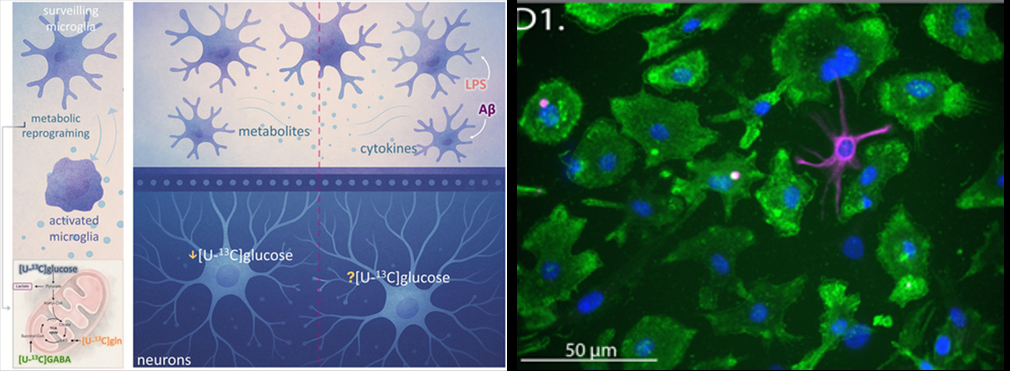
Glial control of brain energy and amino-acid metabolism in the healthy and diseased brain
We investigate the molecular and cellular mechanisms that regulate how energy is produced, distributed and consumed in the brain.
A particular focus is the contribution of glia to neuronal metabolism and the exchange of metabolites and neurotransmitter precursors between different brain-cell populations. These studies aim to define how metabolic cooperation between glia and neurons maintains normal brain homeostasis and how this relationship responds to changing energetic demands.
Recent work from the group has expanded this concept to microglia, demonstrating that these cells can utilise several metabolic substrates and directly influence neuronal metabolism and neurotransmitter homeostasis.
Metabolic alterations occur early in several neurodegenerative disorders. We study how changes in glial metabolism contribute to neuroinflammation, abnormal neurotransmitter homeostasis, neuronal dysfunction and disease progression.
Alzheimer’s disease is a major focus
Using human iPSC-derived brain cells and experimental disease models, we investigate early alterations in astrocytic and microglial metabolism, including glucose metabolism, glutamate transport and amino-acid metabolism.
Our studies of astrocytes have identified increased glucose metabolism together with impaired glutamate transport as potential early features of familial Alzheimer’s disease, while previous metabolic mapping demonstrated alterations in branched-chain amino-acid metabolism in Alzheimer’s disease astrocytes.
We also investigate glial dysfunction in frontotemporal dementia, where metabolic reprogramming and altered inflammatory states in patient-relevant microglial models can influence neuronal survival and function.
Together, these projects seek to identify metabolic vulnerabilities that could become targets for new treatments in Alzheimer’s disease, frontotemporal dementia and other neurodegenerative disorders.
Sex differences in energy metabolism and their link to immunometabolism
Biological sex is a fundamental determinant of physiology, yet its influence on cellular metabolism remains poorly understood. Our studies indicate that healthy female and male brain tissue utilise metabolic substrates in different ways, revealing sex-dependent patterns of energy metabolism that emerge even in the absence of disease.
These differences may be particularly important in the immune system, where metabolic state is closely intertwined with cellular function.
We are exploring how biological sex shapes the metabolic landscape of brain cells and the consequences of these differences for cellular function across health and ageing.
Metabolic interventions with short- and medium-chain fatty acids
A further research direction examines whether alternative metabolic substrates can support brain function when conventional energy metabolism is compromised.
We investigate the cellular mechanisms of short-chain fatty acids (SCFAs) and medium-chain fatty acids (MCFAs) and their effects on neuronal and glial metabolism under physiological and neurodegenerative conditions.
Particular attention is given to decanoic acid (C10) and its ability to act as an auxiliary metabolic substrate. Recent work combining Alzheimer’s disease mouse models, human iPSC-derived astrocytes and 13C metabolic tracing indicates that decanoic acid is efficiently metabolised by astrocytes and may support oxidative brain metabolism when normal metabolic pathways are disturbed.
The broader goal is to determine whether metabolic interventions can be used not simply to compensate for energy deficits but to modify glial function and disease-relevant metabolic pathways pharmacologically.
- Aldana, B. I., & Freude, K. (2026). Chemokines in Alzheimer's disease: Early defence, late damage and the impact of sex and infection. Basic & Clinical Pharmacology & Toxicology, 139(2), Article https://doi.org/10.1111/bcpt.70273
- Westi, E. W., Carlsen, R. B., Andersen, J. V., Kilic, Z., Alnajar, D., Holmgaard, N. K., García Sintes, B., Cota-Coronado, A., Sanz Muñoz, S., Galvagnion, C., & Aldana, B. I. (2025). Metabolic flexibility of microglia: Energy substrate utilization and impact on neuronal metabolism. Journal of Neurochemistry, 169(11), Article e70304. https://doi.org/10.1111/jnc.70304
- Ameen, A. O., Nielsen, S. W., Kjær, M. W., Andersen, J. V., Westi, E. W., Freude, K. K., & Aldana, B. I. (2025). Metabolic preferences of astrocytes: Functional metabolic mapping reveals butyrate outcompetes acetate. Journal of Cerebral Blood Flow & Metabolism, 45(3), 528–541. https://doi.org/10.1177/0271678X241270457
- Ameen, A. O., Rindshøj, M. B., Dittlau, K. S., Borges, K., Freude, K. K., & Aldana, B. I. (2025). Metabolic astrocytic support with decanoic acid enhances energy metabolism in Alzheimer's disease models. Cells, 14(24), Article 2007. https://doi.org/10.3390/cells14242007
- Westi, E. W., Andersen, J. V., & Aldana, B. I. (2023). Using stable isotope tracing to unravel the metabolic components of neurodegeneration: Focus on neuron-glia metabolic interactions. Neurobiology of Disease, 182, Article 106145. https://doi.org/10.1016/j.nbd.2023.106145
- Westi, E. W., Molhemi, S., Hansen, C. T., Skoven, C. S., Knopper, R. W., Ahmad, D. A., Rindshøj, M. B., Ameen, A. O., Hansen, B., Kohlmeier, K. A., & Aldana, B. I. (2024). Comprehensive analysis of the 5xFAD mouse model of Alzheimer's disease using dMRI, immunohistochemistry, and neuronal and glial functional metabolic mapping. Biomolecules, 14(10), Article 1294. https://doi.org/10.1016/j.nbd.2023.106145
- Aldana, B. I. (2019). Microglia-specific metabolic changes in neurodegeneration. Journal of Molecular Biology, 431(9), 1830–1842. https://doi.org/10.1016/j.jmb.2019.03.006
CONTACT
Associate Professor Blanca I. Aldana
MSc thesis projects
We are always interested to hear from motivated students that would like to carry out their MSc thesis work in our group. Please send your CV, grades and a brief text outlining your motivation for joining the group to
blanca.aldana@sund.ku.dk