
The Vector Group has relaunched Myggetal.dk in August 2026 with a new mobile-friendly design, improved graphs, expanded information about Danish mosquitoes, biting midges and ticks, and clearer presentation of the current vector situation in Denmark. Click here
Vector Ecology subgroup (Vector Group)
The Vector Group at KU has conducted research on vectors and vector-borne diseases since 2019 at the University of Copenhagen and from 2006 to 2018 at The National Veterinary Institute, Danish Technical University (DTU).
We work with predictive modelling of vector distribution, vector abundance and vector-borne pathogen prevalence using remote sensing MODIS data and environmental data, machine learning algorithms, mechanistic models and GIS.
The Vector Group furthermore plays a central role in the national surveillance of vectors through the DK-VET contingency work, where we collect vector-related data and ensure its accessibility through Myggetal.dk. Additionally, the Vector Group is involved with risk assessment of emerging and zoonotic pathogens in Denmark and provides analysis for decision support at the Danish Veterinary and Food Administration regarding vectors and vector-borne pathogens.
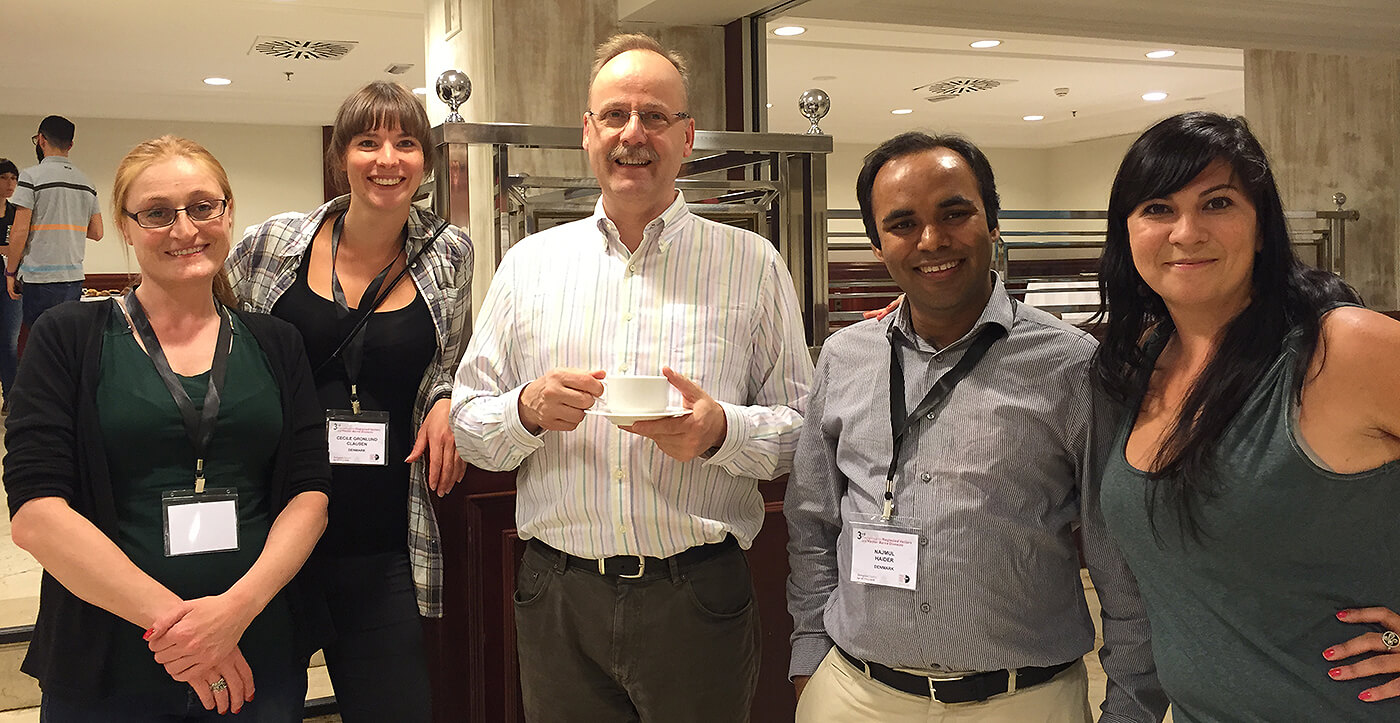
The Vector Group at the European Network for Neglected Vectors and Vector-Borne Infections (EURNEGVEC) conference, Zaragoza, Spain, 2016.
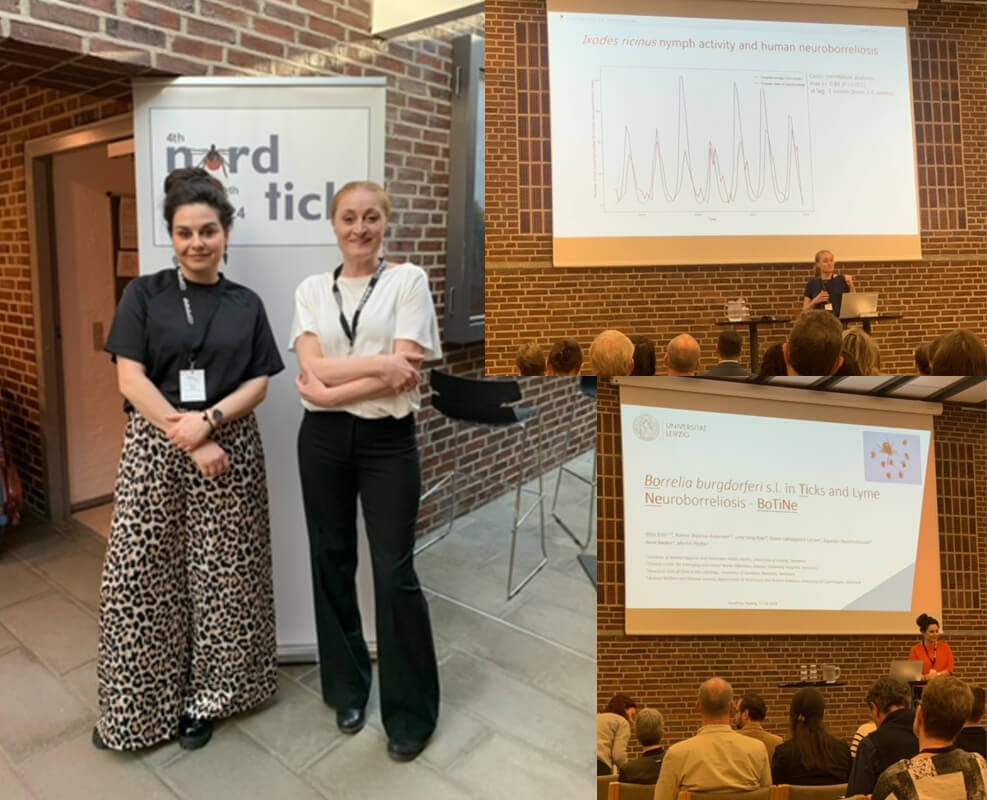 The Vector Group presenting at the NordTick conference, Nyborg, Denmark, 2024.
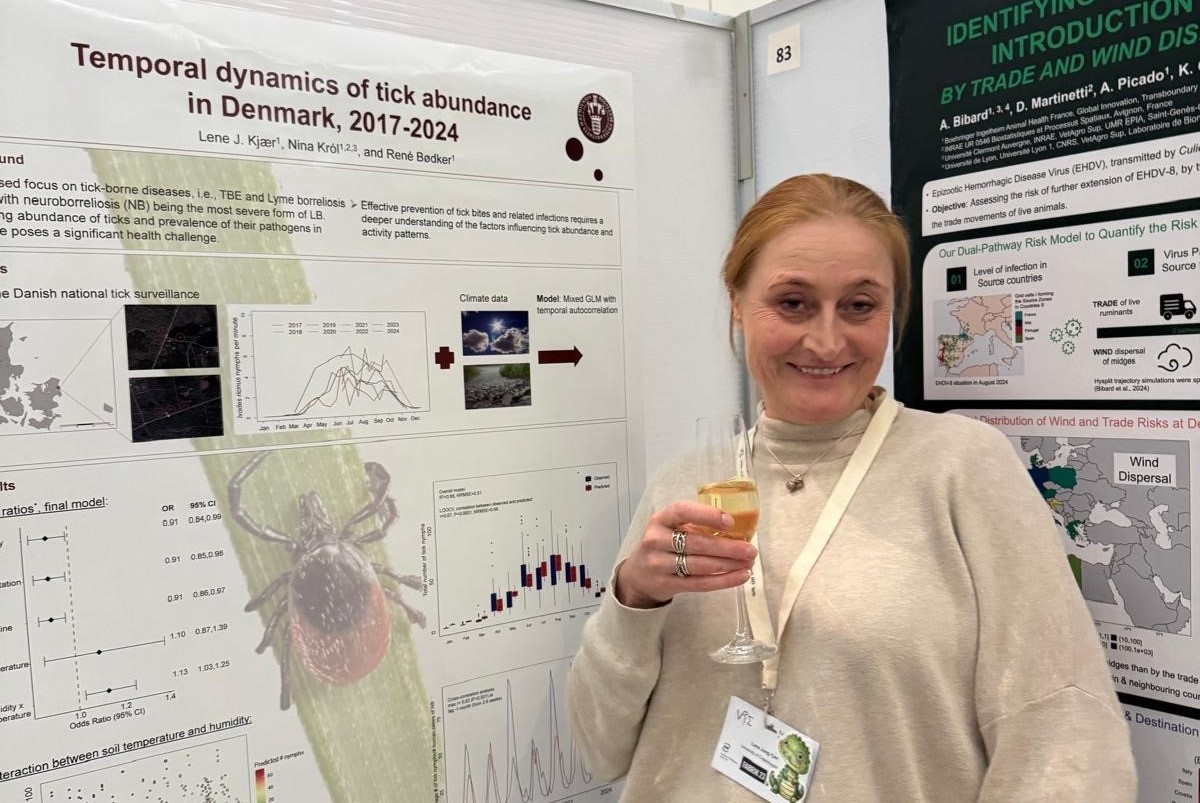
Lene Jung Kjær from the Vector Group at SVEPM in Berlin, 2025
Group information
GROUP LEADER
Rene Bødker
e-mail: rebo@sund.ku.dk
Department of Veterinary and Animal Sciences
University of Copenhagen
Grønnegårdsvej 8
DK-1870 Frederiksberg Campus
Denmark
CONTACT
Lene Jung Kjær
e-mail: lenju@sund.ku.dk
Phone: +45 35337290
Check out our Facebook page
NEWS
Myggetal.dk relaunched with a new design and updated vector-surveillance data
The University of Copenhagen’s Vector Group has relaunched Myggetal.dk, the public platform presenting results from the Danish surveillance of mosquitoes, biting midges and ticks.
The redesigned website makes it easier to explore current and historical surveillance data. Visitors can select individual vector species or groups and view corresponding graphs and information about their biology, seasonal activity and potential importance for disease transmission.
Read more
Shifting Landscapes and Evolving Pathogens: Understanding population vulnerabilities and enhancing health system resilience (SHAPE)
DANIDA has granted 10 mio danish kroner to this project which is a cooperation between Makerere University (Uganda), University of Glasgow og UCPH. Lene Jung Kjær is PI on the project and other participants from UCPH are Matt Denwood, Arshnee Moodley, Marta Canuti and Britt Pinkowski Tersbøl.
Read more
Dr. Nina Król, Research Fellow
- Jonno Stelder (2019-2022)
- Najmul Haider (2016-2018)
- Ana Caroline Cuellar (2016-2018)
- Carsten Kirkeby (2010-2013)
- Frederiksberg Hospital
- Linköping University
- Norwegian Institute of Public Health
- Norwegian University of Life Sciences
- Odense University Hospital
- Region Jönköping County
- Roskilde University
- Swedish Veterinary Agency (SVA), Sweden
- Swedish University of Agricultural Sciences
- Sørlandet Hospital Health Enterprise
- Technical University of Denmark
- University of Agder
- University of Agricultural Sciences and Veterinary Medicine of Cluj-Napoca
- University of Leipzig
- University of Veterinary Medicine Cluj, Romania
- Örebro University
- Department of Agriculture, Food and the Marine, Ireland
- Estonian University of Life Sciences
- Finnish Food Authority (Ruokavirasto)
- Institute of Food Safety, Animal Health and Environment (BIOR), Latvia
- Icelandic Food and Veterinary Authority (MAST)
- Makerere University
- National Food and Veterinary Risk Assessment Institute, Lithuania
- National Veterinary Institute, Norway
- National Veterinary and Food Laboratory (LABRIS), Estonia
- Statens Serum Institut
- University of Glasgow
SHAPE – Shifting Landscapes and Evolving Pathogens
SHAPE is a DANIDA-funded research project investigating how changes in landscapes, climate and human activities influence the emergence and transmission of infectious diseases in Uganda. The project combines One Health research on pathogens, animals, people and the environment with analyses of population vulnerability and health-system resilience.
Through field studies, laboratory investigations, epidemiological and spatial modelling, and social-science research, SHAPE aims to identify emerging disease risks and strengthen the capacity to prevent, detect and respond to future outbreaks. The project is coordinated by the University of Copenhagen in collaboration with Makerere University and the University of Glasgow, with close involvement of the Uganda National One Health Platform.
NOREVA – Northern European Vector-borne disease Assessment consortium
NOREVA brings together veterinary, public-health and research institutions from Denmark, Sweden, Finland, Norway, Iceland, Ireland, Estonia, Latvia and Lithuania. The consortium supports the joint programming of risk assessments for vector-borne diseases in Northern Europe.
The project will strengthen regional collaboration by harmonising methods, identifying shared data and research needs, improving surveillance and horizon scanning, and developing coordinated approaches to emerging vector-borne disease risks. The University of Copenhagen coordinates the consortium, with Sweden serving as co-coordinator. NOREVA is funded by the European Food Safety Authority (EFSA).
OH4Surveillance 2024-2027:
EU (HaDEA) funded project in collaboration with 19 other partners in Europe. Here we run an intensive West Nile virus surveillance program in Denmark and develop mechanistic virus transmission models to identify the optimal surveillance strategies (risk based surveillance).
Alpha-gal: Red meat allergy in Denmark: an underrecognized cause of urticaria, angioedema and delayed allergic shock (2022-2024):
This project is a collaboration with Frederiksberg Hospital and is funded by the Independent Research Fund Denmark. Red meat allergy, caused by the carbohydrate alpha-gal in beef, pork, and lamb, is a potentially life-threatening condition characterized by hives and anaphylaxis hours after ingestion. Its prevalence in Denmark is unclear, but evidence suggests a link to tick bites. Accurate diagnosis is crucial for effective treatment—avoidance of red meat. The aim of the project is to enhance diagnosis and treatment by identifying at-risk populations in Denmark, and involves:
1) Epidemiological, clinical, and register-based studies to determine prevalence, trends, and risk factors.
2) Spatial predictive modelling of risk-factors and hotspots of high prevalence to geographically identify and pinpoint at-risk populations in Denmark.
ScandTick Innovation (2015–2018
ScandTick Innovation was a Scandinavian One Health collaboration involving universities, hospitals and public authorities in Denmark, Norway and Sweden. The project aimed to improve knowledge, diagnostics, prevention and communication concerning ticks and tick-borne infections.
The Vector Group contributed by collecting Ixodes ricinus ticks across southern Scandinavia, screening them for tick-borne pathogens and analysing the environmental and climatic factors affecting their geographical distribution. We developed predictive spatial distribution maps for Ixodes ricinus, screened for the potential introduction of Ixodes persulcatus and Dermacentor reticulatus, and mapped the prevalence of pathogens in questing ticks.
Selected scientific outputs from the project include:
- Prediction of the spatial abundance of Ixodes ricinus in southern Scandinavia. https://www.nature.com/articles/s41598-019-54496-1
- Mapping human exposure risk to Ixodes ricinus nymphs in Denmark, Norway and Sweden. https://pubmed.ncbi.nlm.nih.gov/30862329/
- Large-scale screening for Ixodes persulcatus and Dermacentor reticulatus. https://pmc.ncbi.nlm.nih.gov/articles/PMC6617640/
- Spatial datasets describing tick abundance and pathogen prevalence across southern Scandinavia. https://www.nature.com/articles/s41597-020-00579-y
- Analysis of spatial patterns in pathogen prevalence among questing Ixodes ricinus nymphs. https://www.nature.com/articles/s41598-020-76334-5
Peer reviewed publications
- Kjær, L. J., M. Johansson, P. E. Lindgren, N. Asghar, P. Wilhelmsson, H. Fredlund, M. Christensson, A. Wallenhammar, R. Bødker, G. Rasmussen, and P. Kjellander. 2023. Potential drivers of human tick-borne encephalitis in the Örebro region of Sweden, 2010-2021. Scientific Reports 13(1):7685.
- Wint, G. R. W., T. Balenghien, E. Berriatua, M. Braks, C. Marsboom, J. Medlock, F. Schaffner, W. Van Bortel, N. Alexander, B. Alten, E. Czwienczek, S. Dhollander, E. Ducheyne, C. M. Gossner, K. Hansford, G. Hendrickx, H. Honrubia, T. Matheussen, A. D. Mihalca, D. Petric, J. Richardson, H. Sprong, V. Versteirt, and O. Briet. 2023. VectorNet: collaborative mapping of arthropod disease vectors in Europe and surrounding areas since 2010. Eurosurveillance. 28, 26-29, 2200666
- Saegerman C., M. F. Humblet, M. Leandri. G. Gonzalez, P. Heyman, H. Sprong, M. L'Hostis, S. Moutailler, S. I. Bonnet, N. Haddad, N. Boulanger, S. L. Leib, T. Hoch, E. Thiry, L. Bournez, J. Kerlik, A. Velay, S. Jore, E. Jourdain, E. Gilot-Fromont, K. Brugger, J. Geller, M. Studahl, N. Knap, T. Avšič-Županc, D. Růžek, T. P. Zomer, R. Bødker, T. F: H. Berger, S. Martin-Latil, N. De Regge, A. Raffetin, S. A. Lacour, M. Klein, T. Lernout, E. Quillery, Z. Hubálek, F. Ruiz-Fons, A. Estrada-Peña, P. Fravalo, P. Kooh, F. Etore, C. M. Gossner, and B. Purse. 2023. First Expert Elicitation of Knowledge on Possible Drivers of Observed Increasing Human Cases of Tick-Borne Encephalitis in Europe. Viruses. 15, 3, 791.
- Bakran-Lebl, K., L. J. Kjær, and B. Conrady. 2023. Predicting Culex pipiens/restuans Population Dynamics Using a Weather-Driven Dynamic Compartmental Population Model. Insects, 14(3), 293.
- Lamsal, A., K. S. Edgar, A. Jenkins, H. Renssen, L. J. Kjær, K. Alfsnes, S. Bastakoti, M. Dieseth, K. Klitgaard, H. E. H. Lindstedt, K. M. Paulsen, R. Vikse, L. Korslund, V. Kjelland, S. Stuen, P. Kjellander, M. Christensson, M. Teräväinen, L. M. Jensen, M. Regmi, D. Giri, L. Marsteen, R. Bødker, A. Soleng, and Å. K. Andreassen. 2023. Prevalence of tick-borne encephalitis virus in questing Ixodes ricinus nymphs in southern Scandinavia and the possible influence of meteorological factors. Zoonoses and Public Health 00, 1-12.
- Olesen, A. S., J. J. Stelder, K. Tjørnehøj, C. M. Johnston, L. Lohse, L. J. Kjær, A. E. Boklund, A. Bøtner, G. J. Belsham, R. Bødker, and T. B. Rasmussen. 2023. Detection of African Swine Fever Virus and Blood Meals of Porcine Origin in Hematophagous Insects Collected Adjacent to a High-Biosecurity Pig Farm in Lithuania; A Smoking Gun? Viruses, 15(6), 1255.
- Stelder, J. J., A. S. Olesen, G. J. Belsham, T. B. Rasmussen, A. Bøtner, L. J. Kjær, A. E. Boklund, and R. Bødker. 2023. Potential for introduction of African swine fever virus into high-biosecurity pig farms by flying hematophagous insects. Transboundary and Emerging Diseases 2023, pp. 1-15.
- Stelder, J. J., A. D. Mihalca, A. S. Olesen, L. J. Kjær, A. E. Boklund, T. B. Rasmussen, M. Marinov, V. Alexe, O. M. Balmoş, and R. Bødker. 2023. Potential mosquito vector attraction to-and feeding preferences for pigs in Romanian backyard farms. Frontiers in Veterinary Science 9, 1046263.
- Wint, G. R., T. B. William, E. Berriatua, M. Braks, C. Marsboom, J. Medlock, F. Schaffner, W. Van Bortel, N. Alexander, B. Alten, E. Czwienczek, S. Dhollander, E. Ducheyne, C. M. Gossner, K. Hansford, G. Hendrickx, H. Honrubia, T. Matheussen, A. D. Mihalca, D. Petric, J. Richardson, H. Sprong, V. Versteirt, O. Briet. VectorNet: collaborative mapping of arthropod disease vectors in Europe and surrounding areas since 2010. Euro Surveill. 2023;28(26):pii=2200666.
- Kjær, L. J., and E. M. Schauber. 2022. The effect of landscape, transmission mode and social behavior on disease transmission: Simulating the transmission of chronic wasting disease in white-tailed deer (Odocoileus virginianus) populations using a spatially explicit agent-based model. Ecological Modelling 472:110114.
- Kjær L. J., and R. Bødker. 2022. Scandinavia and Ticks in a Changing Climate pp 90-95. In Climate, Ticks and Disease (ed. P. Nuttall).
- Stelder, J. J., L. J. Kjær, L. B. Jensen, A. E. Boklund, M. Denwood, M. Carlsen, and R. Bødker. 2021. Livestock-associated MRSA survival on house flies (Musca domestica) and stable flies (Stomoxys calcitrans) after removal from a Danish pig farm. Scientific Reports 11(1):1-10.
- Kjær, L. J., L. M. Jensen, M. Chriél, R. Bødker, and H. H. Petersen. 2021. The raccoon dog (Nyctereutes procyonoides) as a reservoir of zoonotic diseases in Denmark. International Journal for Parasitology: Parasites and Wildlife 16:175-182.
- Cuéllar, A. C., L. J. Kjær, A. Baum, A. Stockmarr, H. Skovgard, S. A. Nielsen, M. G. Andersson, A. Lindström, J. Chirico, R. Lühken, S. Steinke, E. Kiel, J. Gethmann, F. J. Conraths, M. Larska, M. Smreczak, A. Orłowska, I. Hamnes, S. Sviland, P. Hopp, K. Brugger, F. Rubel, T. Balenghien, C. Garros, I. Rakotoarivony, X. Allène, J. Lhoir, D. Chavernac, J. C. Delécolle, B. Mathieu, D. Delécolle, M. L. Setier-Rio, B. Scheid, M. Á. M. Chueca, C. Barceló, J. Lucientes, R. Estrada, A. Mathis, R. Venail, W. Tack, R. Bødker. 2020. Modelling the monthly abundance of Culicoides biting midges in nine European countries using Random Forests machine learning. Parasites & Vectors 13(1):1-18.
- Mignotte, A., C. Garros, L. Gardès, T. Balenghien, M. Duhayon, I. Rakotoarivony, L. Tabourin, L. Poujol, B. Mathieu, A. Ibañez-Justicia, A. Deniz, A. Cvetkovikj, B. V. Purse, D. W. Ramilo, D. Stougiou, D. Werner, D. Pudar, D. Petrić, E. Veronesi, F. Jacobs, H. Kampen, I. Pereira da Fonseca, J. Lucientes, J. Navarro, J. Martinez de la Puente, J. Stefanovska, K. R. Searle, K. Khallaayoune, C. L. Culverwell, M. Larska, M. Bourquia, M. Goffredo, M. Bisia, M. England, M. Robin, M. Quaglia, M. Á. Miranda-Chueca, R. Bødker, R. Estrada-Peña, S. Carpenter, S. Tchakarova, S. Boutsini, S. Sviland, S. M. Schäfer, Z. Ozoliņa, Z. Segliņa, Z. Vatansever, and K. Huber. 2020. The tree that hides the forest: cryptic diversity and phylogenetic relationships in the Palaearctic vector Obsoletus/Scoticus Complex (Diptera: Ceratopogonidae) at the European level. Parasites Vectors 13, 265 (2020).
- Kjær, L. J., K. Klitgaard, A. Soleng, K. S. Edgar, H. E. H. Lindstedt, K. M. Paulsen, Å. K. Andreassen, L. Korslund, V. Kjelland, A. Slettan, S. Stuen, P. Kjellander, M. Christensson, M. Teräväinen, A. Baum, L. M. Jensen, and R. Bødker. 2020. Spatial data of Ixodes ricinus instar abundance and nymph pathogen prevalence, Scandinavia, 2016-2017. Scientific Data 7:238.
- Kjær, L. J., K. Klitgaard, A. Soleng, K. S. Edgar, H. E. H. Lindstedt, K. M. Paulsen, Å. K. Andreassen, L. Korslund, V. Kjelland, A. Slettan, S. Stuen, P. Kjellander, M. Christensson, M. Teräväinen, A. Baum, L. M. Jensen, and R. Bødker. 2020. Spatial patterns of pathogen prevalence in questing Ixodes ricinus nymphs in southern Scandinavia, 2016. Scientific Reports 10[1):1-14.
- Balenghien, T., N. Alexander, A. L. Arnþórsdóttir, M. Bisia, A. Blackwell, R. Bødker, M. Bourquia, S. Boutsini, S. Carpenter, C. Colenutt, L. Culverwell, A. Cvetkovikj, L. Dascălu, N. De Regge, S. Dhollander, A. Elbers, M. England, S. Filatov, C. Garros, M. Goffredo, N. Haddad, T. T. Høye, D. Hristescu, K. Khallaayoune, A. Kočišová, M. Larska, J. Lucientes, B. Mathieu, M. A. Miranda, A. Murchie, C. Nițescu, Z. Ozoliņa, I. Pereira da Fonseca, D. Petrić, D. Pudar, D. Ramilo, J. Richardson, Z. Seglina, S. Sghaier, J. Stefanovska, D. Stougiou, S. Sviland, S. Tchakarova, W. Van Bortel, M. Verdun Castello, E. Veronesi, V. Versteirt, and W. G. R. Wint. 2020. VectorNet Data Series 3: Culicoides Abundance Distribution Models for Europe and Surrounding Regions. Open Health Data, 7: 2.
- Olesen A. N., J. B. Graham, T. B. Rasmussen, L. Lohse, R. Bødker, T. Halasa, A. Boklund, A. Bøtner. 2020. Potential routes for indirect transmission of African swine fever virus into domestic pig herds. Transboundary and Emerging Diseases. Vol 67, p1472-1484.
- Andreasen, A. M., P. B. Dehlendorff, F. C. Knudtzen, R. Bødker, L. J. Kjær, and S. Skarphedisson. 2020. Spatial and temporal patterns of Lyme Neuroborreliosis on Funen, Denmark from 1995–2014. Scientific Reports 10(1):7796.
- Hernández‐Triana L. M., V. A. Brugman, P. Pramual, E. Barrero, N. I. Nikolova, I. Ruiz‐Arrondo, A. Kaiser, A. Krüger, S. Lumley, H. C. Osório, A. Ignjatović‐Ćupina, D. Petrić, M. Laure Setier‐Rio, R. Bødker, and N. Johnson. 2020. Genetic diversity and population structure of Culex modestus across Europe: does recent appearance in the United Kingdom reveal a tendency for geographical spread? Medical and Veterinary Entomology (2020) 34, 86–96.
- Agergaard C. N., M. W. Rosenstierne, R. Bødker, M. Rasmussen, P. H. S. Andersen, and A. Fomsgaard. 2019. New tick-borne encephalitis virus hot spot in Northern Zealand, Denmark, October 2019. Euro Surveill. 2019;24(43):pii=1900639.
- Petersen, A., M. W. Rosenstierne, M. Rasmussen, K. Fuursted, H. V. Nielsen, L. O. Andersen, R. Bødker, and A. Fomsgaard. 2019. Field samplings of Ixodus ricinus ticks from a tick-borne encephalitis virus micro-focus in Northern Zealand, Denmark. Ticks and Tick-borne Diseases, Vol. 10, No. 5, 2019, p. 1028-103.
- Klitgaard K., J. Højgaard, A. Isbrand, J. J. Madsen, K. Thorup, and R. Bødker. 2019. Screening for multiple tick-borne pathogens in Ixodes ricinus ticks from birds in Denmark during spring and autumn migration seasons. Ticks Tick Borne Dis. 2019 Jan 24. pii: S1877-959X(18)30126-2.
- Kjær, L. J., A. Soleng, K. S. Edgar, H. E. H. Lindstedt, K. M. Paulsen, Å. K. Andreassen, L. Korslund, V. Kjelland, A. Slettan, S. Stuen, P. Kjellander, M. Christensson, M. Teräväinen, A. Baum, K. Klitgaard, and R. Bødker. 2019. Predicting the spatial abundance of Ixodes ricinus ticks in southern Scandinavia using environmental and climatic data. Scientific Reports 9(1):1-16.
- Haider, N., L. J. Kjær, H. Skovgård, S. A. Nielsen and R. Bødker. 2019. Quantifying the potential for bluetongue virus transmission in Danish cattle farms. Scientific Reports 9(1):13466.
- Kjær, L. J., A. Soleng, K. S. Edgar, H. E. H. Lindstedt, K. M. Paulsen, Å. K. Andreassen, L. Korslund, V. Kjelland, A. Slettan, S. Stuen, P. Kjellander, M. Christensson, M. Teräväinen, A. Baum, A. Isbrand, L. M. Jensen, K. Klitgaard, and R. Bødker. 2019. A large-scale screening for the taiga tick, Ixodes persulcatus, and the meadow tick, Dermacentor reticulatus, in southern Scandinavia, 2016. Parasites & Vectors 12(1): 338.
- Kjær, L. J., A. Soleng, K. S. Edgar, H. E. H. Lindstedt, K. M. Paulsen, Å. K. Andreassen, L. Korslund, V. Kjelland, A. Slettan, S. Stuen, P. Kjellander, M. Christensson, M. Teräväinen, A. Baum, K. Klitgaard, and R. Bødker. 2019. Predicting and mapping human risk of exposure to Ixodes ricinus nymphs using climatic and environmental data, Denmark, Norway and Sweden, 2016. Eurosurveillance 24(9): 1-11.
- Klitgaard, K., L. J. Kjær, A. Isbrand, M. F. Hansen, and R. Bødker. 2019. Multiple infections in questing nymphs and adult female Ixodes ricinus ticks collected in a recreational forest in Denmark. 2019. Ticks and Tick-borne Diseases 10(5): 1060-1065.
- Cuéllar, A. C., L. J. Kjær, C. Kirkeby, H. Skovgard, S. A. Nielsen, A. Stockmarr, G. Andersson, A. Lindstrom, J. Chirico, R. Lühken, S. Steinke, E. Kiel, J. Gethmann, F. J. Conraths, M. Larska, I. Hamnes, S. Sviland, P. Hopp, K. Brugger, F. Rubel, T. Balenghien, C. Garros, I. Rakotoarivony, X. Allène, J. Lhoir, D. Chavernac, J.-C., Delécolle, B. Mathieu, D. Delécolle, M.-L. Setier-Rio, R. Venail, B. Scheid, M. Á. M. Chueca, C. Barceló, J. Lucientes, R. Estrada, A. Mathis, W. Tack and R. Bødker. 2018. Monthly variation in the probability of presence of adult Culicoides populations in nine European countries and the implications for targeted surveillance. Parasites & Vectors 11(608): 1-19.
- Byriel, D., B. Kristensen, K. Klitgaard, and R. Bødker. 2018. Relative abundance and geographical variation of Culex pipiens and Culex torrentium (Diptera: Culicidae) in CO2 -baited traps in Denmark. Entomol. Fennica 29, 112-18
- Gondard, M., L. Michelet, A. Nisavanh, E. Devillers, S. Delannoy, P. Fach, A. Aspan, K. Ullman, J. Chirico, B. Hoffmann, F. J. van der Wal, A. de Koeijer, C. van Solt-Smits, S. Jahfari, H. Sprong, K. L. Mansfield, A. R. Fooks, K. K. Klitgaard, R. Bødker, and S. Moutailler. 2018. Prevalence of tick-borne viruses in Ixodes ricinus assessed by high-throughput real-time PCR. Pathogens and Disease, Vol. 76, 8, 2018.
- Olesen, A. S., M. F. Hansen, T. B. Rasmussen., G. J. Belsham, R. Bødker, and A. Bøtner. 2018. Survival and localization of African swine fever virus in stable flies (Stomoxys calcitrans) after feeding on viremic blood using a membrane feeder. Veterinary Microbiology. 222, August 2018, 25-29.
- Haider, N, A. C. Cuellar, L. J. Kjær, J. H. Sørensen and R. Bødker. 2018. Microclimatic temperatures at Danish cattle farms, 2000–2016: quantifying the temporal and spatial variation in the transmission potential of Schmallenberg virus. Parasites & Vectors 11(128): 1-14.
- Haider, N, S. Laaksonen, L. J. Kjær, A. Oksanen and R. Bødker. 2018. The annual, temporal and spatial pattern of Setaria tundra outbreaks in Finnish reindeer: a mechanistic transmission model approach. Parasites & Vectors 11(565): 1-13.
- Cuéllar, A. C., L. J. Kjær, C. Kirkeby, H. Skovgard, S. A. Nielsen, A. Stockmarr, G. Andersson, A. Lindstrom, J. Chirico, R. Lühken, S. Steinke, E. Kiel, J. Gethmann, F. J. Conraths, M. Larska, I. Hamnes, S. Sviland, P. Hopp, K. Brugger, F. Rubel, T. Balenghien, C. Garros, I. Rakotoarivony, X. Allène, J. Lhoir, D. Chavernac, J.-C., Delécolle, B. Mathieu, D. Delécolle, M.-L. Setier-Rio, R. Venail, B. Scheid, M. Á. M. Chueca, C. Barceló, J. Lucientes, R. Estrada, A. Mathis, W. Tack and R. Bødker. 2018. Spatial and temporal variation in the abundance of Culicoides biting midges (Diptera: Ceratopogonidae) in nine European countries. Parasites & Vectors 11(112): 1-18.
- Schou K. K, M. Chriél, A. Isbrand, T. K. Jensen, and R. Bødker. 2017. Identification of Dermacentor reticulatus Ticks Carrying Rickettsia raoultii on Migrating Jackal, Denmark. Emerging Infectious Diseases 23, 12, 6 p.
- Haider, N., C. T. Kirkeby, B. Kristensen, L. J. Kjær, J. H. Sørensen and R. Bødker. 2017. Microclimatic temperatures increase the potential for vector-borne disease transmission in the Scandinavian climate. Scientific Reports, vol: 7: 1-12.
- Jensen, P. M., C. S. Christoffersen, S. Moutailler, L. Michelet, K. K. Schou, and R. Bødker. 2017. Transmission differentials for multiple pathogens as inferred from their prevalence in larva, nymph and adults of Ixodes ricinus (Acari: Ixodidae). Experimental & Applied Acarology. 71, 2, p. 171-182.
- Faverjon C., A. Leblond, S. Lecollinet, R. Bødker, A. A. de Koeijer, and E. A. J. Fischer. 2016. Comparative Risk Analysis of Two Culicoides-Borne Diseases in Horses: Equine Encephalosis More Likely to Enter France than African Horse Sickness. Transboundary and Emerging Diseases. 12 p.
- EFSA Panel on Animal Health and Welfare. Scientific opinion on Echinococcus multilocularis infection in animals. EFSA Journal 2015.
- Olsen, A., K. Frankena, R. Bødker, N. Toft, S. M. Thamsborg, H. L. Enemark, and T. Halasa. 2015. Prevalence, risk factors and spatial analysis of liver fluke infections in Danish cattle herds. Parasites & Vectors, 8:160.
- Bødker, R., K. K. Klitgaard, D. B. Byriel, and B. Kristensen. 2015. Establishment of the West Nile virus vector, Culex modestus, in a residential area in Denmark. Journal of Vector Ecology, vol: 39, issue: 2, 2014.
- Græsbøll, K., C. Enøe, R. Bødker, and L. E. Christiansen. 2014. Optimal vaccination strategies against vector-borne diseases. Spatial and Spatio-temporal Epidemiology 11,153-162.
- Lorraine, M., S. Delannoy, E. Devillers, G. Umhang, A. Aspan, M. Juremalm, J. Chirico, F. J. van der Wal, T. P. B. Pihl, K. K. Schou, R. Bødker, P. Fach, S. Moutailler. 2014. High-throughput screening of tick-borne pathogens in Europe. Frontiers in Cellular and Infection Microbiology, 4, 103.
- Rasmussen, L. D., C. Kirkeby, R. Bødker, B. Kristensen, T. B. Rasmussen, G. J. Belsham, and A. Bøtner. 2013. Rapid Spread of Schmallenberg Virus-infected Biting Midges (Culicoides spp.) across Denmark in 2012. Transboundary and Emerging Diseases 2013
- Stockmarr, A., R. Bødker, and L. R. Nielsen. 2013. Dynamic changes in antibody levels as an early warning of Salmonella Dublin in bovine dairy herds. J. Dairy Sci. 96:7558-7564.
- Fomsgaard, A., M. E. Fertner, S. Essbauer, A. Y. Nielsen, S. Frey, P. Lindblom, P. E. Lindgren, R. Bødker, M. Weidmann, and G. Dobler. 2013. Tick-borne encephalitis virus, Zealand, Denmark 2011. Emerging Infectious Diseases, vol 19, no 7, 1171-1173.
- Kirkeby, C., R. Bødker, A. Stockmarr, and P. Lind. 2013. Spatio-temporal optimization of sampling for bluetongue vectors (Culicoides) near grazing animals. Parasites & Vectors. 6:151.
- Kirkeby, C., R. Bødker, A. Stockmarr P. Lind, and P. M. H. Heegaard. 2013. Quantifying Dispersal of European Culicoides (Diptera: Ceratopogonidae) Vectors between Farms Using a Novel Mark-Release-Recapture Technique. P L o S One, vol: 8, issue: 4, pages: e61269, 2013.
- Kirkeby, C., K. Græsbøll, A. Stockmarr, L. E. Christiansen, and R. Bødker. 2013. The range of attraction for light traps catching Culicoides biting midges (Diptera: Ceratopogonidae). Parasites & Vectors, vol: 6, issue: 67, 2013.
- Kirkeby, C., R. Bødker, A. Stockmarr, and P. Lind. 2013. Spatial abundance and clustering of Culicoides (Diptera: Ceratopogonidae) on a local scale. Parasites & Vectors 2013, 6:43 doi:10.1186/1756-3305-6-43.
- Græsbøll K., R. Bødker, C. Enøe, and L. E. Christiansen. 2012. Simulating spread of Bluetongue Virus by flying vectors between hosts on pasture. Scientific Reports 2, doi:10.1038/srep00863.
- Balenghien, T., R. Bødker, A. Bøtner, S. Gubbins, A. Koeijer, A. Wilson, M. Beer, J. C. Abrahantes , K. Willgert, A. Afonso, J. Richardson, A. Vlachou, E. Christoph, F. Berthe, and D. Verloo. 2012. "Schmallenberg" virus: Analysis of the Epidemiological Data and Assessment of Impact EFSA Journal 2012.
- Rasmussen, L. D., B. Kristensen, C. Kirkeby, T. B. Rasmussen, G. J. Belsham, R. Bødker, and A. Bøtner. 2012. Culicoids as Vectors of Schmallenberg Virus. Emerging Infectious Diseases vol: 18, issue: 7, 2012.
- Fertner, M. E., L. Mølbak, T. P. Boye Pihl, A. Fomsgaard, and R. Bødker. 2012. First detection of tick-borne “Candidatus Neoehrlichia mikurensis” in Denmark 2011. Eurosurveillance, Volume 17, Issue 8, 23 February 2012
- Kirkeby, C., R. Bødker, A. Stockmarr, and C. Enøe. 2009. Association between land cover and Culicoides (Diptera: Ceratopogonidae) breeding sites on four Danish cattle farms. Entomologica Fennica 2009 Vol. 20 No. 4 pp. 228-232).
- Fomsgaard, A., C. B. Christiansen CB, and R. Bødker. 2009. First identification of tick-borne encephalitis in Denmark outside of Bornholm, August 2009. Euro Surveill. 2009;14(36)
- Vieira, A. R., H. Houe, H. C. Wegener, D. M. A. Lo Fo Wong, R. Bødker, and H. D. Emborg. 2008. Spatial scan statistics to assess sampling strategy of antimicrobial resistance monitoring programme. Foodborne Pathogens and Disease 6(1): 15-21.
- Baggesen, D., L. R. Nielsen, G. Sørensen G, R. Bødker, and A. K. Ersbøll. 2007. Growth inhibitory factors in bovine faeces impairs detection of Salmonella Dublin by conventional culture procedure. Journal of Applied Microbiology 103:650-656.
- Bødker, R., H. A. Msangeni, W. Kisinza, and S. W. Lindsay. 2006. Relationship between the intensity of exposure to malaria parasites and infection in the Usambara Mountains, Tanzania. Am. J. Trop. Med. Hyg. 74(5):716-723.
- Balls, M. J., R. Bødker, C. J. Thomas, W. Kisinza, H. A. Msangeni, and S. W. Lindsay. 2004. Effect of topography on the risk of malaria infection in the Usambara Mountains, Tanzania. Trans R Soc Trop Med Hyg. 98:400-408.
- Jensen, A. N., G. Sørensen, D. L. Baggesen, R. Bødker, and J. Hoorfar. 2003. Addition of Novobiocin in pre-enrichment step can improve Salmonella culture protocol of modified semisolid Rappaport-Vassiliadis. J Microbiol Methods. Oct;55(1):249-55.
- Bødker, R., J. Akida, D. Shayo, W. Kisinza, H. A. Msangeni, E. M. Pedersen, and S. W. Lindsay. 2003. Relationship between altitude and intensity of malaria transmission in the Usambara Mountains, Tanzania. J Med Entomol. Sep;40(5):706-17.
- Bendixen, M., H. A. Msangeni, B. V. Pedersen, D. Shayo, and R. Bødker. (2001). Diversity of Plasmodium falciparum populations and complexity of infections in relation to transmission intensity and host age: a study from the Usambara Mountains, Tanzania. Trans R Soc Trop Med Hyg. Mar-Apr;95(2):143-8.
- Bødker, R., W. Kisinza, R. Malima, H. A. Msangeni, and S. W. Lindsay. 2000. Resurgence of malaria in the Usambara mountains, Tanzania, an epidemic of drug-resistant parasites. Global Change & Human Health. Dec;1(2):134:153.
- Lindsay, S. W., R. Bødker, R. Malima, H. A. Msangeni, and W. Kisinza. 2000. Effect of 1997-98 El Nino on highland malaria in Tanzania. Lancet. Mar 18;355(9208):989-90.
- Bødker, R., O. Orum, B. Teisner, E. M. Pedersen, R. Thompson, and B. Hogh. 1995.
- Aminopropeptide of human procollagen type I: a marker for the identification of blood from children in the mosquito blood meal. Trans R Soc Trop Med Hyg. Jul-Aug;89(4):449-53.
Popular science publications and reports
- Olesen, A. S., J. J. Stelder, L. J. Kjær, A. E. Boklund, A. Bøtner, G. J. Belsham, R. Bødker, T. B. Rasmussen, and L. Lohse. 2023. Vektorbårne sygdomme: Identifikation af værtspræferencer ud fra påvisning af blodmåltider i insekter. Dansk Veterinærtidsskrift 3, 2023.
- Kjær, L. J. You probably don’t know a lot about the tick. 2023. Opinion post. University Post, University of Copenhagen, 22 August 2023.
- Bødker, R., L. Lohse, P. Jokelainen, A. M. Michelsen, S. Ciera, M. Fredholm, and L. J. Kjær. 2023. Vectorborne zoonoses in Annual Report on Zoonoses in Denmark 2022, Technical University of Denmark pp. 17-19.
- Bødker, R., L. J. Kjær, P. Jokelainen, R. Trebbien, A. E. Boklund, and L. E. Larsen. 2022. Risikovurdering af zoonotiske virus og andre agens, der kan forekomme i dyr og kan have epidemisk potentiale. Report, University of Copenhagen.
- Bødker, R., M. Reipurth, A. S. V. Hammer, L. Lohse, and L. J. Kjær. 2022. Vectorborne zoonoses in Annual Report on Zoonoses in Denmark 2021, Technical University of Denmark pp. 17-20.
- Bødker, R., E. Thorhauge-Thejll, L. J. Kjær, J. J. Stelder, and A. E. Boklund. 2021. Vectorborne zoonoses in Annual Report on Zoonoses in Denmark 2020. Technical University of Denmark, pp. 23-24
- Bødker, R., and L. J. Kjær. 2020. Endnu et nyt hotspot for flåtbåren TBE i Danmark. Dansk Veterinærtidsskrift 5, 2020.
- Kjær, L. J. 2020. The beauty of the Scandinavian Landscape – a story of blood, sweat, tears and hysteria in the Scandinavian forests. Blog in Research Data, Springer Nature.
- Bødker, R., L. Lohse, and L. J. Kjær. 2020. Vectorborne zoonoses in Annual Report on Zoonoses in Denmark 2019, Technical University of Denmark pp. 17-19.
- Bødker, R., L. J. Kjær, and K. K. Schou. 2019. Vectorborne zoonoses in Annual Report on Zoonoses in Denmark 2018. National Food Institute, Technical University of Denmark, pp. 22-23.
- Bødker, R. L. J. Kjær, and K. K. Schou. 2018. Tag ikke engflåter med hjem fra ferien. 2018. Dansk Veterinærtidsskrift 8, 2018.
- Bødker, R., L. J. Kjær, M. F. Hansen, A. Petersen, L. Lohse, and K. K. Schou. 2018. Vectorborne zoonoses in Annual Report on Zoonoses in Denmark 2017. National Food Institute, Technical University of Denmark, pp. 24-25.
- Ocias, L. F., A. Petersen, K. A. Krogfelt, M. W. Rosenstierne, A. Fomsgaard, and R. Bødker. 2017. Infektion med TBE-virus i Danmark 2013-2016. EPI - Nyt. 40.
- Rasmussen, L. D., B. Kristensen, C. Kirkeby, T. B. Rasmussen, G. Belsham, R. Bødker, and A. Bøtner. 2012. Schmallenberg virus fundet i mitter i Danmark. Dansk Veterinaertidsskrift vol: 5, pages: 45, 2012.
- Christiansen, C. B., A. Fomsgaard, and R. Bødker. 2010. Et nyt flavivirus er dukket op i baghaven. Dansk Selskab for Rejsemedicin Nyhedsbrev 15: 3-6.
- Fomsgaard, A., K. Mølbak, C. B. Christiansen, and R. Bødker. 2009. TBE påvist i Nordsjælland. EPI-NYT Uge 35.
- Bødker, R., A. Pedersen, and S. Ethelberg. 2009. Spatio-temporal cluster analysis of ten selected salmonella serotypes in Europe, 2001-2006. Report to MedVetNet: 1-82
- Bødker, R., and A. B. Christoffersen. 2008. Udbredelse af den bakterielle zoonose Q-feber i danske kvægbesætninger. En epidemiologisk analyse af laboratoriedata fra 2007. Dansk Veterinærtidsskrift; 91:16-22.
- Bødker, R., C. Maddox-Hyttel, and H. Vigre. 2006. Evaluation of the risk of spread of Echinococcus multilocularis from Denmark to Sweden. DFVF Risk Assessment Report. J. nr. 55017-0005.
- Vigre, H., A. Bøtner, P. H. Jørgensen, S. E. Jorsal, S. Kabell, V. F. Jensen, P. Lind, A. Stockmarr, R. Bødker, J. H. Sørensen, J. T. Graversen, and J. Christensen. 2006. Risikovurdering gennemført af Danmarks Fødevareforskning vedr. effekten af at fjerne loftet på 500 dyreenheder pr. landbrugsejendom. Danmarks Fødevareforskning.
- Bødker, R. and S. Aabo. 2003. Sammenhæng mellem blodantistoffer og fækal udskillelse af S. Dublin hos slagtekalve. Technical Report, DVI 55034.
Group members
| Name | Title | Phone | |
|---|---|---|---|
| Anne Marie Michelsen | Academic Research Staff | +4535322475 | |
| Júlia Cabrera I Cortada | PhD Fellow | +4535336134 | |
| Lene Jung Kjær | Associate Professor | +4535337290 | |
| René Bødker | Senior Researcher | +4535325262 | |
| Sarah Falck | Research Assistant | +4535323726 |