
Laboratory Animal Science and Welfare
Our research group is doing research, education and training, dissemination and advice and assistance in the fields of laboratory animal science, laboratory animal welfare, and comparative medicine. We have a strong focus on the 3Rs – the Refinement, Reduction and Replacement of laboratory animal experimentation, as well as on ensuring the highest possible validity and quality of animal experimentation.
Research
We are working within four specific focus areas, as outlined below:
Minimizing pain and discomfort in rodent models of the highest severity classification
In the European framework for severity classification of animal experiments, many animal studies are classified as mild – the lowest rating on the scale. For these cases, the ethical aspects relate more to compromising he animal’s integrity rather than the impact on their welfare. However, a limited number of rodents experience the highest degree of severity and suffering, when they are used as models for burdensome human diseases.
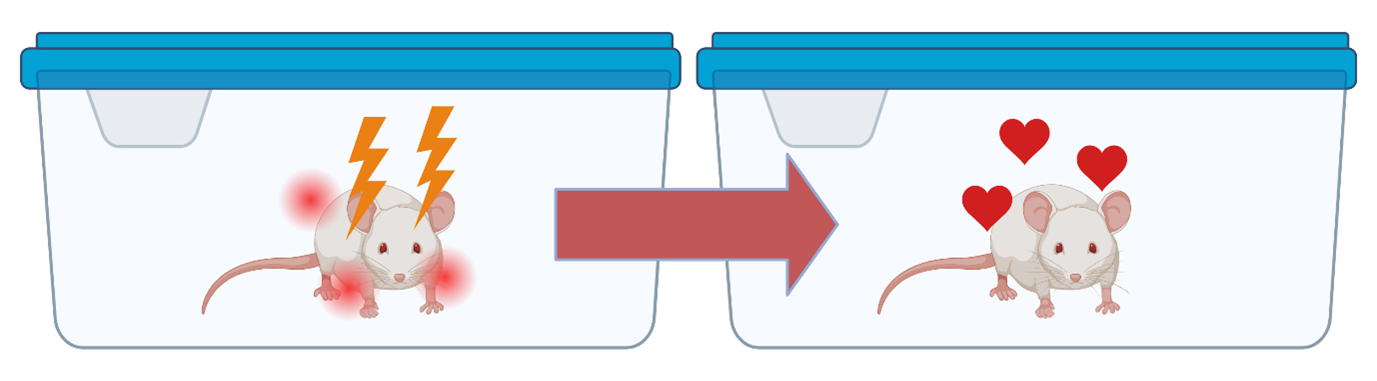
- Developed non-invasive methods for biochemical assessment of pain-related stress
- Developed methods for non-invasive delivery of analgesic drugs
- Refined animal models of neuropathic and inflammatory pain, by making analgesic treatment possible with none or minimal effect on the model validity
- Compared methods for blood sampling to elucidate welfare issues associated with standard sampling techniques
What we do in ongoing studies
- refine and improve methods for recognizing, assessing, and alleviating pain and stress.
- refine experimental procedures for anaesthesia, analgesia, experimental surgery, blood samplings and injections, with a special focus on optimizing animal models of moderate to high severity, increasing both welfare of the animals and validity of the models
Improvement of animal models through microbiota techniques
Within many research areas it is difficult to reproduce studies and to translate the results into therapies for human patients. This - by far - constitutes the largest waste of animal lives in preclinical research. This is particularly rooted in the lack of a natural gut microbiome and pathogen exposure in the clean rodent barrier facilities which have resulted in divergent microbiomes among mice from different facilities, and limited ability to predict complex immune responses of humans. We aim to reduce variation and increase precision and validity in animal studies by addressing these issues of our modern-day rodent facilities.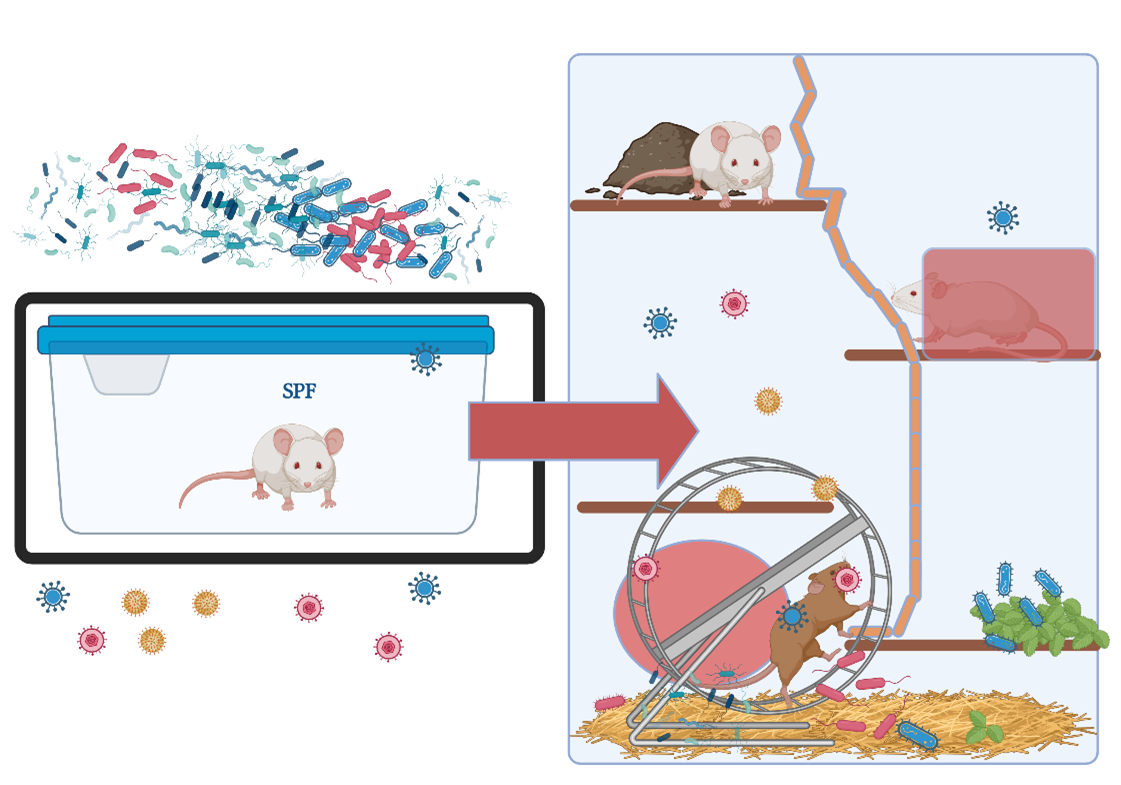
- Preimmunization with inactivated murine pathogens to mimic natural infections in the ‘too clean’ laboratory rodents to induce an immune system more comparable to humans in a safe manner.
- Transfer of wild mouse microbiota to laboratory mice to ‘dirty’ up the clean barrier-housed animals lacking various important bacteria in their gut that are essential for development of human analogue immune responses.
- Naturalisation of the housing environment for mice to maximize welfare and maintain a diverse gut microbiome resembling wild mice.
- Transplanted human microbiomes to germ-free mice to establish more translational animal models for obesity and metabolic disorders, inflammatory bowel disease, allergy, and asthma
- Humanizing mouse models of obesity and metabolic disorders by genetically generating a human-like toll-like receptor panel in the mice
- Developed a model to increase power in rodent studies by incorporation of microbiota sequencing data in data evaluation.
What we do in ongoing studies
- make laboratory rodents more human-like by humanizing their diet and microbiota-host interactions.
- reduce groups sizes in rodent studies by finding ways to incorporate the microbiota of the animals into study design and evaluation.
Leveraging the power of meta-analysis to replace redundant animal experiments
With millions of biomedical studies being published every year, there is a vast ocean of pre-existent preclinical data. Re-use and repurposing of this data is an extremely underutilized resource. A study is carried out and its results are published, never to be touched again. This is a shame, since many questions that we may ask around laboratory animal experimentation can be answered without sacrificing any animals. Instead, we could often apply meta-analytical techniques for evidence synthesis and generate an answer to a new question using these old, published, studies. Not only are we replacing animal experiments, but we are generating much stronger answers, combining evidence from dozens of studies and hundreds, if not thousands, of animals.
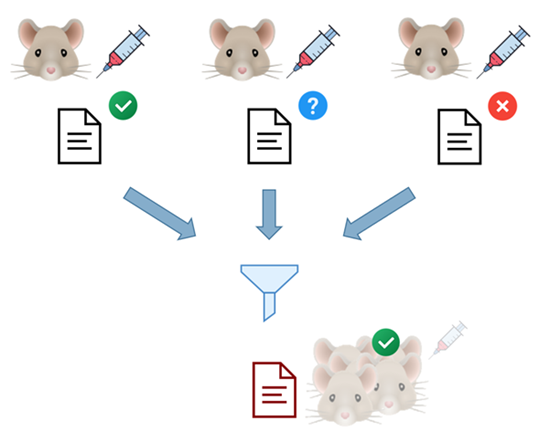
Using meta-analytical methods, we can combine evidence from multiple studies, to produce a much stronger evidence base also for answering new questions. When the results from the individual studies are inconsistent, we can dispel ambiguity – producing a clear answer using data from all the animals sacrificed in the individual studies.
- Developed methods for interrogating methods in biomarker analysis and behavior-based neuroscience. Comparisons made without the use of a single animal. Which methods are useful and how should they be applied?
- Demonstrated how unfounded methodologies can be laid bare and eliminated from practice. Hypotheses tested without the use of a single animal. What is the evidence-base for this method? Is it built on a solid foundation?
- Built international collaborations for meta-analytical evidence synthesis in preclinical medicine.
What we do in ongoing studies
- develop an already internationally recognized hub for meta-analysis of preclinical studies
- increase international collaboration with similar hubs for meta-analysis
- develop new methodologies and tools for ever-refined meta-analytical evidence synthesis
- incorporate recently developed machine learning tools for handling larger datasets and an increased level of automation
Animal-centric handling and housing of laboratory animals
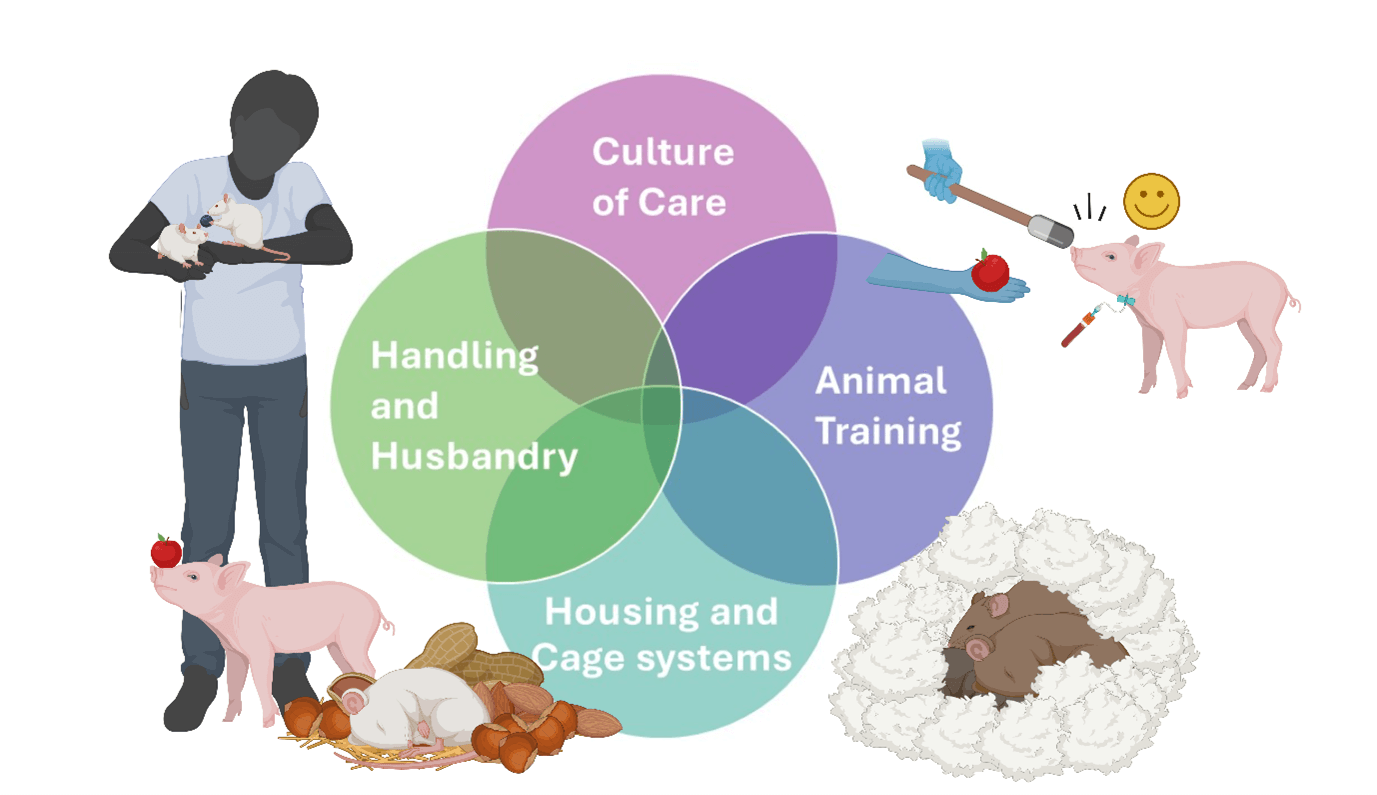
We aim to promote Culture of Care that supports a compassionate and respectful approach to animal care and welfare, while also being mindful of the well-being of the animal care staff. We will expand the knowledge on implementation and use of animal welfare enhancing methods for handling and housing laboratory animals through the entire life span of each animal. Hence, we aim to develop, test and disseminate housing systems including colony-housing that will contribute to better animal welfare. We will implement and further develop handling- and training methods and protocols that will promote enhanced animal welfare during daily husbandry as well as experimental procedures.
Refined housing and handling are important factors to prioritize, as they will have a positive effect on animal welfare, quality of research data and the overall validity of animal models.
- Tunnel handling in mice has been implemented as refined handling of mice on Campus Frederiksberg. We have been participating in training of staff at Nørre Campus.
- Tunnel handling in mice combined with cued, voluntary entry into tunnel has been tested for transportation in colony-housed mice.
- Pigs have been trained using operant conditioning to voluntarily participate in jugular vein blood sampling. A training protocol has been developed.
- Initial testing on colony-housing of mice in EC4rats (Scanbur A/S) has been done and a project on colony housing and the effect on animal welfare and physiology has been launched.
What we do in ongoing studies
- expand the knowledge on operant training in pigs for voluntary blood sampling
- provide training protocols for socialization of rats in colony housing ensuring that the rats will approach the handler voluntarily and without fear or hesitation
- increase knowledge on how to socialize mice in colony housing to ensure that the mice will approach the handler voluntarily and without fear or hesitation
- continuously improve our own standards and develop a Culture of Care, where our animal handling and husbandry are better than what is required by law and the staff and researchers have an animal-centric approach to our animals.
- promote interdisciplinary collaboration and ensure that all good ideas for refined housing and husbandry are taken seriously and tested in a collaborative effort between animal care staff and researchers.
Teaching and training
Our teaching and training activities are designed to contribute to the optimal training of researchers, animal care staff and others involved in working with laboratory animals at the university, in Denmark and the rest of the world.
We offer accredited courses in laboratory animal science on EU Function A, B and D levels for staff on all levels working with animal experimentation. Our accredited courses primarily cover the species-specific parts for rodents and pigs, and we also collaborate with other groups to cover other species-specific courses. We also offer education for full certification of designated veterinarians, according to the EU Directive.
Furthermore, we run and develop courses for continuing professional development, within laboratory animal science, laboratory animal welfare and comparative medicine, such as experimental design, animal training, anaesthesia, analgesia, and surgical techniques.
CALAR
What is CALAR?
CALAR is a research unit with researchers from public institutions and private enterprises with focus on improving the welfare of experimental animals as well as the scientists working in a modern experimental facility.
CALAR's mission
is to optimise animal as well as human welfare through research par excellence. It is our vision that working with experimental animals models and being an experimental animal in a modern experimental animal unit will be perceived positively.
 |
 |
More information on the group is available in Danish
LabVet Europe is the online programme to fulfill the European requirements to Designated Veterinarians as stated in the European Union Directive 2010/63/EU.
The LabVet Europe programme qualifies you to work as Designated Laboratory Animal Veterinarian in accordance with the 2010 EU directive on the protection of animals used for scientific purposes and the subsequent guidance paper.
The LabVet Europe programme is an online programme designed to give Laboratory Animal Veterinarians knowledge and skills needed in your daily work as a Designated Veterinarian.
Staff
| Name | Title | Phone | |
|---|---|---|---|
| Search in Name | Search in Title | Search in Phone | |
| Axel Kornerup Hansen | Professor | +4535332726 | |
| Camilla Hartmann Friis Hansen | Associate Professor | +4535333756 | |
| Carl Sichlau Bruun | Laboratory Technician | +4535325103 | |
| Daniel Kylmann Hansen | Animal Keeper | ||
| Dorte Bratbo Sørensen | Associate Professor | +4535332724 | |
| Helene Farlov | Animal Keeper | +4535333115 | |
| Helene Dragelund Garcia | PhD Fellow | +4535320893 | |
| Klas Abelson | Professor | +4535335575 | |
| Mette Nelander | Animal Keeper | +4535333770 | |
| Morten Malmberg | PhD Fellow | ||
| Nicole Gutman | Veterinarian | +4535329750 | |
| Otto Kalliokoski | Associate Professor | +4535327012 | |
| Pernille Colding-Jørgensen | PhD Fellow | ||
| Petra Buhr | Research Assistant | +4535324990 | |
| Sara Hestehave | Assistant Professor | +4535331106 | |
| Trine Marie Ahlman Glahder | Laboratory Technician | +4535335576 |
Contact
Group leader:
Professor Klas Abelson
Ridebanevej 9
1870 Frederiksberg C
Ph: +45 35 33 55 75
Secretariat:
Helle Vinberg